Nutritional Support for Cats With Kidney Disease When Prescription Food Is Not Enough
Your vet handed you a bag of renal food. Your cat sniffed it once and walked away.
Now you are standing in the kitchen at 11pm, worried and out of ideas. Almost every cat owner facing chronic kidney disease hits this exact wall.
Chronic kidney disease in cats responds to nutritional support beyond prescription food alone. Phosphorus binders, potassium, B vitamins, omega 3 fatty acids, and veterinarian formulated renal supplements can all play a role. These work alongside a diet your cat will actually eat, guided by bloodwork and your veterinarian.
You have more options than you think. Let us walk through them.
Why Renal Diets Come First, and Where They Fall Short
Therapeutic renal diets are the most studied nutritional tool in feline CKD. They earn their place as first line care.
What a therapeutic renal diet actually changes
A prescription kidney diet is not just "low protein." It is a reformulation of several nutrients at once.
-
Reduced phosphorus to limit mineral buildup
-
Moderated, high quality protein to lower waste products
-
Added potassium to replace urinary losses
-
Added omega 3 fatty acids (EPA and DHA)
-
Added B vitamins and antioxidants
-
Controlled sodium
Why diet alone is not the whole plan
Here is the part nobody tells you at the appointment. A renal diet only works if your cat eats it every single day.
Cats with kidney disease often feel nauseated. Nausea plus a brand new food equals food aversion.
Cost, multi cat households, and late stage appetite loss all interfere too. Renal nutrition for cats has to survive real life, not just a feeding chart.
That is where layered support becomes valuable.
When Your Cat Refuses the Prescription Renal Food
If your cat refuses the renal diet, do not starve her into accepting it. A cat that stops eating for 48 hours faces serious risk. Call your veterinarian, feed a food she will eat, and add targeted nutritional support to compensate for what the diet is not providing. Eating something is better than eating nothing.
Why so many cats reject renal diets
Reduced protein changes the aroma. Cats lead with smell, not taste.
Many cats also associate the new food with feeling unwell. That link sticks fast and lasts long.
The "fed is best" principle
Veterinarians weigh two risks against each other. One is dietary phosphorus. The other is weight loss and muscle wasting.
Malnutrition usually wins that argument. A thin, uneating cat declines faster than one eating a slightly imperfect diet.
Your first 72 hours when refusal starts
-
Stop the pressure. Remove the rejected food and offer something familiar.
-
Call your vet. Ask about nausea control and appetite support.
-
Warm the food slightly. Aroma improves acceptance in many cats.
-
Try a different renal brand or texture. Pate, chunks, and gravy perform differently.
-
Ask about lower phosphorus non prescription options. Several exist and are worth discussing.
-
Discuss a phosphate binder. This lets you feed a food she accepts while still limiting phosphorus absorption.
-
Track intake daily. Weigh the bowl. Guessing hides problems.
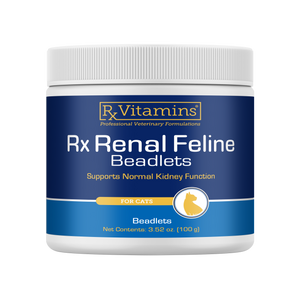
If your cat rejects anything mixed into her food, format matters enormously. Tasteless, odorless options like Rx Renal Feline Beadlets exist specifically for that problem.
Phosphorus Control Without a Prescription Diet
This is the highest impact lever you have. It is also the one most owners miss.
Why phosphorus matters so much
Damaged kidneys stop clearing phosphorus efficiently. Blood levels rise quietly, long before you see symptoms.
Rising phosphorus drives FGF-23 upward and triggers secondary hyperparathyroidism. Higher phosphorus levels are associated with shorter survival in cats with CKD.
Controlling it is one of the few interventions with strong evidence behind it.
How phosphate binders work
A phosphate binder mixes into food and binds dietary phosphorus inside the gut. The bound phosphorus leaves through the stool instead of entering the bloodstream. Binders only work when given with meals. Given between meals, they do almost nothing, because there is no dietary phosphorus present to bind.
Binder types compared
|
Binder type |
Common form |
Notes |
|
Aluminum hydroxide |
Fine powder |
Widely used, tasteless, mixes into wet food easily |
|
Chitosan with calcium carbonate |
Powder |
Shellfish derived, also binds some uremic toxins |
|
Calcium carbonate |
Powder or chew |
Calcium levels need monitoring |
|
Lanthanum carbonate |
Powder |
Less commonly used in cats |
When binders typically enter the plan
Your veterinarian usually considers a binder when blood phosphorus climbs toward the upper end of the IRIS target for your cat's stage. Many vets also add one earlier when a renal diet is refused, since dietary restriction is off the table.
Phos-Bind 35 gm and Phos-Bind 200 gm are aluminum hydroxide powders formulated for veterinary use. Ask your vet whether a binder fits your cat's current bloodwork.
Potassium and B Vitamins: What CKD Cats Lose Through Urine
Cats with kidney disease urinate more. Water soluble nutrients leave with that urine, every day.
Signs of low potassium in cats
Hypokalemia is common and easy to overlook. Watch for these changes:
-
Weakness in the hind legs
-
A lowered head or neck posture (ventroflexion)
-
Reduced appetite
-
Stiff, reluctant movement
-
General lethargy
Why B vitamins run low
B vitamins dissolve in water. Increased urine output flushes them out steadily.
Low B vitamin status can itself reduce appetite. That creates a loop, since poor appetite worsens everything else.
Test before you supplement
Do not guess on potassium. Some cats need more, and a small number need less.
A blood panel answers this in minutes. Ask for potassium on every recheck.
Combination formulas such as Amino B+K pair amino acids with B vitamins and potassium in a liquid your cat can take with food.
Omega 3 Fatty Acids and Antioxidant Support
Kidney damage brings inflammation and oxidative stress. Nutrition can influence both.
What EPA and DHA do
Omega 3 fatty acids are among the better supported supplements in feline kidney care. EPA and DHA help support a normal inflammatory response and have been linked to reduced protein loss in urine. Veterinary nutritionists commonly suggest a combined total of roughly 500 to 600 mg of EPA plus DHA per cat per day, adjusted by your veterinarian.
Quality matters more than dose
Fish oil oxidizes. Rancid oil tastes bad and offers less benefit.
Check for a clear EPA and DHA breakdown on the label. Vague "fish oil" amounts tell you nothing useful.
Store it cool and use it within the recommended window.
Vitamin E and antioxidant balance
Adding omega 3s raises vitamin E needs. Good formulas account for that.
Antioxidants including vitamin E and vitamin C have been studied for reducing oxidative stress in cats with reduced kidney function. Explore fatty acid options in the everyday health collection and discuss amounts with your vet.
Uremic Toxins and the Gut Connection
Failing kidneys let waste compounds build up. Some of those compounds start in the gut.
Gut bacteria produce substances such as indoxyl sulfate. Healthy kidneys clear them. Damaged kidneys do not.
What is available
Probiotic and toxin binding products aim to interrupt that process. Some use bacterial cultures. Others use porous carbon or chitosan to trap compounds in the intestine.
An honest note
Evidence here is mixed. Some studies show benefits, others show little.
These products are reasonable to discuss, but they are not a foundation. Phosphorus control, hydration, and calorie intake matter more.
Botanical and Nutraceutical Renal Formulas
Multi ingredient renal formulas combine botanical extracts with amino acids and antioxidants.
Common ingredients and their roles
-
Astragalus root extract for antioxidant support
-
Rehmannia glutinosa used traditionally in renal formulations
-
Rhubarb extract studied in kidney support contexts
-
N-acetylcysteine as an antioxidant precursor
-
Milk thistle (silymarin) for antioxidant and liver support
-
L-arginine and L-glutamine as functional amino acids
Why formulation accuracy matters
A long ingredient list means nothing without amounts. Dusting is common in cheap supplements.
Look for labels that state milligram amounts per capsule or serving. Vagueness is a warning sign.
Questions to ask before buying
-
Does the label list exact amounts for every active ingredient?
-
Is it formulated specifically for cats, not just scaled down from a dog product?
-
Does the company sell through veterinary professionals?
-
Does the format suit a cat who resists pills?
-
Does the brand avoid disease treatment claims?
Rx Renal Feline capsules and the beadlet version are formulated to support normal kidney function in cats. Both list exact ingredient amounts on the label.
Hydration, Appetite, and Daily Comfort
These two factors shape daily quality of life more than any supplement.
Getting more water in
-
Feed wet food as the primary diet whenever possible
-
Add warm water or low sodium broth to meals
-
Place several water bowls around the house
-
Try a circulating fountain, since many cats prefer moving water
-
Use wide, shallow bowls that avoid whisker contact
When appetite becomes the limiting factor
Nausea is treatable. Do not accept "she is just picky" as the final answer.
Your veterinarian can discuss anti nausea medication and appetite support. Many cats eat well again once nausea is controlled.
Comfort matters too
Raise food bowls slightly for arthritic seniors. Keep litter boxes close and easy to enter.
Small adjustments protect intake and dignity at the same time.
Matching Nutritional Support to Your Cat's IRIS Stage
IRIS staging tells you where your cat sits and what support makes sense. Stages run from 1 through 4, based on creatinine and SDMA, with substaging by protein loss and blood pressure. Early stages focus on phosphorus and antioxidant support. Later stages shift toward appetite, hydration, and comfort. Ask your vet which stage applies to your cat.
|
Stage |
Main nutritional priorities |
|
Stage 1 |
Phosphorus awareness, hydration, omega 3s, baseline bloodwork, weight tracking |
|
Stage 2 |
Renal diet trial, phosphorus control, omega 3s, antioxidant support, potassium checks |
|
Stage 3 |
Active phosphorus binding, potassium and B vitamin support, calorie protection, nausea control |
|
Stage 4 |
Palatability and calories first, hydration support, comfort focused care, simplified regimen |
Ready to build your cat's plan?
Bring this table to your next appointment. Ask which layers fit your cat's stage and current bloodwork.
Then explore veterinarian formulated options in the pet kidney support supplements collection from Rx Vitamins.
Veterinary professionals: request a wholesale account to stock Rx Vitamins formulations for your renal patients.
How to Actually Give Supplements to a Difficult Cat
The best supplement is the one your cat will take every day.
Format comparison
|
Format |
Best for |
|
Beadlets |
Cats who detect anything unusual in food. Tasteless and odorless |
|
Powders |
Mixing into wet food when flavor is not an issue |
|
Capsules |
Cats who tolerate pilling, or owners who open and sprinkle |
|
Liquids |
Precise dosing and syringe administration |
Protecting against food aversion
Never force a new supplement into a meal your cat already dislikes. You will lose both.
Start with a small amount mixed into a favorite food. Increase gradually over several days.
Building a routine that lasts
Pick one time of day and stay consistent. Keep the container visible.
Stack supplements with an existing habit like the morning feeding. Consistency beats intensity in chronic care.
What to Monitor and How Often
Nutritional support without monitoring is guesswork. Bloodwork tells you whether the plan works.
Values to recheck
-
Creatinine and SDMA
-
Blood urea nitrogen (BUN)
-
Phosphorus
-
Potassium
-
Urine protein to creatinine ratio (UPC)
-
Urine specific gravity
-
Blood pressure
-
Body weight and muscle condition
Recheck cadence
Most stable cats are rechecked every three to six months. Newly diagnosed or unstable cats need closer monitoring.
Your veterinarian sets the schedule based on stage and response.
Do not stack everything at once
Add one supplement at a time. Give it a few weeks.
If something causes a problem, you will know which one. Stacking five products at once tells you nothing.
An Honest Look at What the Evidence Shows
You deserve clarity, not marketing. Here is where things actually stand.
Strong support: phosphorus restriction and binding, hydration, and maintaining adequate calorie intake.
Moderate support: omega 3 fatty acids, potassium supplementation when deficiency is confirmed, and antioxidant nutrients.
Limited or mixed support: several popular probiotic and toxin binding products, and many single botanical claims.
No supplement cures chronic kidney disease. Nothing reverses it.
What good nutritional support can do is help maintain normal function, support comfort, and fill gaps a rejected diet leaves behind. That is a worthwhile goal on its own.
Where Rx Vitamins Fits in a Veterinarian Directed Plan
Rx Vitamins has developed nutritional formulations for companion animals since 1998.
Built for the veterinary channel
These formulas were designed with veterinary professionals in mind, not for supermarket shelves. That shapes every decision, from ingredient amounts to administration format.
Every active ingredient appears on the label with a stated amount. No proprietary blends hiding the details.
The feline kidney support range
-
Rx Renal Feline capsules with botanical extracts and amino acids
-
Rx Renal Feline Beadlets in a tasteless, odorless format
-
Phos-Bind aluminum hydroxide phosphate binder in two sizes
-
Amino B+K liquid with amino acids, B vitamins, and potassium
-
Cranberry Rx for urinary tract support
Your next step
Print this article or save the link. Bring it to your veterinarian.
Ask which layers fit your cat's stage, appetite, and bloodwork. Then browse the kidney supplements for cats range and choose the format your cat will actually accept.
Questions about a formulation? Reach the Rx Vitamins team at 800-792-2222 or through the contact page.
Frequently Asked Questions
Can I feed regular food to a cat with kidney disease?
Yes, when your cat refuses a prescription renal diet. A food your cat eats consistently beats a therapeutic food she rejects. Ask your veterinarian about lower phosphorus non-prescription options and whether a phosphate binder should be added to offset the higher phosphorus content.
Do kidney supplements for cats actually work?
Some have solid evidence, others do not. Phosphorus binders and omega 3 fatty acids have the strongest support. Potassium helps when bloodwork confirms a deficiency. No supplement cures chronic kidney disease. They work best as one layer inside a veterinarian directed plan with regular monitoring.
When should a cat start a phosphate binder?
Typically when blood phosphorus rises above the IRIS target range for your cat's stage. Many veterinarians start earlier if your cat refuses a renal diet, since dietary restriction is unavailable. Binders must be given with meals to bind phosphorus in food.
How much omega 3 should I give a cat with CKD?
Veterinary nutritionists commonly reference roughly 500 to 600 mg of combined EPA and DHA per cat per day. Check the label for the actual EPA and DHA amounts, not just total fish oil. Confirm the right amount with your veterinarian before starting.
What is the best supplement format for a cat that hates pills?
Tasteless, odorless beadlets and fine powders work best. They mix into wet food without changing smell or texture, which matters because cats detect food changes by aroma. Liquids also work well for cats who accept syringe dosing during regular feeding times.
Can supplements replace a prescription renal diet?
No. Supplements complement a diet, they do not replace one. If your cat refuses renal food, supplements plus a binder help fill the gap. That combination is a practical compromise, not an equal substitute. Your veterinarian should approve the approach.
How often should my cat's bloodwork be rechecked?
Stable cats are usually rechecked every three to six months. Newly diagnosed cats, unstable cats, or those starting new support often need rechecks every four to eight weeks. Your veterinarian sets the schedule based on IRIS stage and response.
Are kidney supplements safe to combine with medications?
Often yes, but timing matters. Phosphate binders can interfere with absorption of some medications, so separate dosing is sometimes advised. Always share a full list of supplements and medications with your veterinarian before adding anything new.
Content reviewed for compliance with NASC structure and function guidelines. These statements have not been evaluated by the Food and Drug Administration. This product is not intended to diagnose, treat, cure, or prevent any disease. Rx Vitamins products are intended for use under veterinary supervision. Always consult your veterinarian before changing your cat's diet or supplement plan.
Trusted Supplements for Healthier, Happier Pets
Explore our most popular veterinarian-formulated supplements, thoughtfully developed to support your pet's everyday health and wellness.